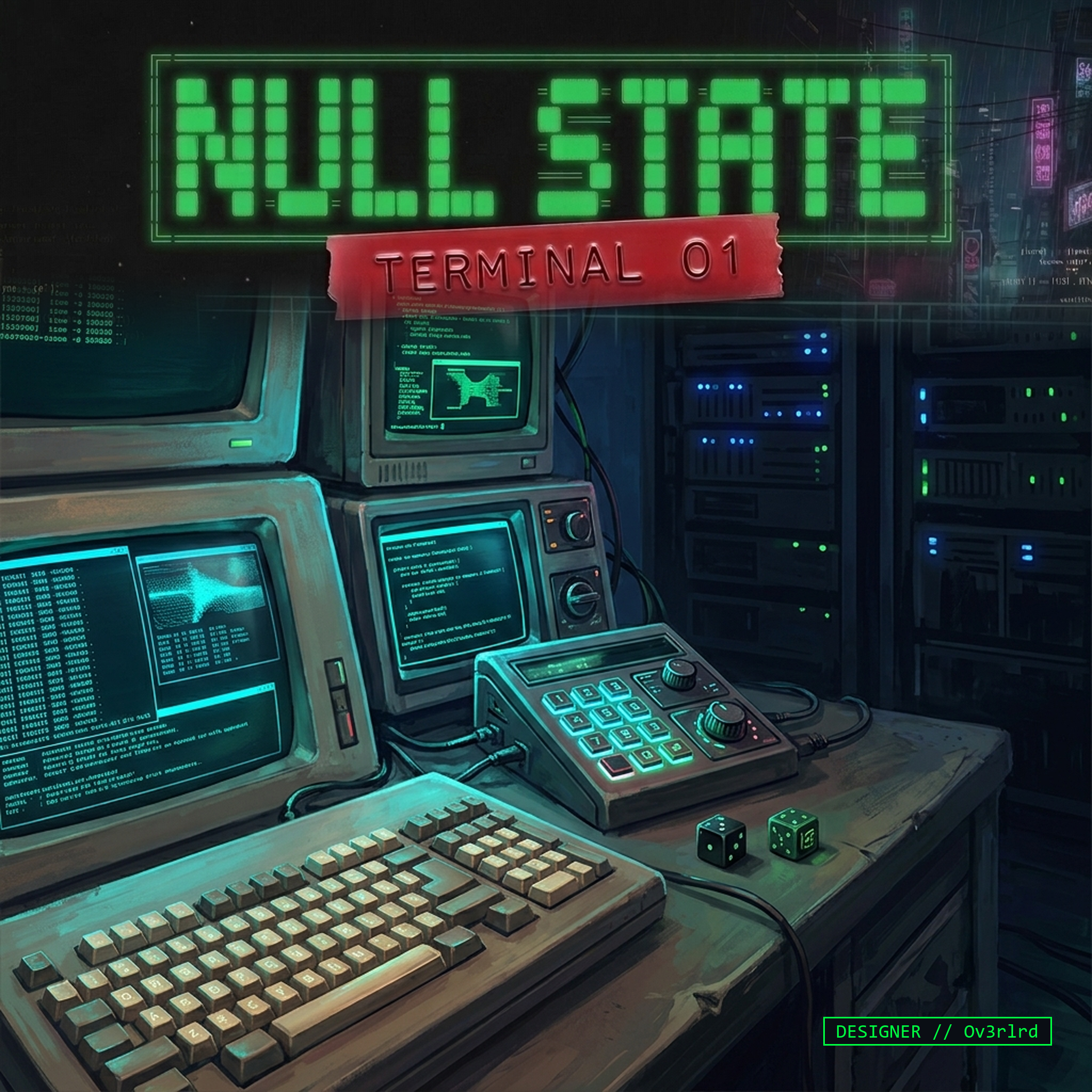
Null State™ Terminal 01
Rulebook
Build v1.2 — Trade Protocol & Layout Refactor Build
Null State: Terminal 01 — Game Rules
When systems collapse, morality is a liability: only control and notoriety remain. Build custom memory stacks, drop malicious rootkits under high-value server nodes, and hijack rival hacks in real time. Claim your fame on the public blockchain, or get purged from the system.
Components
- Gameboard — Markets (6 tracks, 1–10), market track price indicators (Black / Grey / White hat costs driven by market tiers), network scan die (1–6), Crypto Die (1–6), data card deck area.
- Data cards — Deck of data cards. Each card has Scripts (e.g., HKT, CRD, PRT), SYSM value, and information type (AI Intel, Government, Financial, Personal, Market Intel, Dark Web). A card's strength is equal to the number of printed Scripts on that card (each Script counts as 1 strength). Hand limit: 7. If you ever have more than 7 data cards in hand, discard down to 7 immediately to the data discard pile. This represents a Data Purge — you cannot hold more than 7 data cards at a time.
- Location cards — Use 3 cards for 2 players, 6 cards for 3–4 players, and 9 cards for 5 players; one is turned face up at start. At the start of each new round of play, reveal one new location at random until the max number of locations is revealed. Each location lists required Scripts, fame reward, and reward spots (granting Hat market cards, blockchain placements, or data cards via Network Scan).
- Market cards — Three decks (Black hat, Grey hat, White hat), each with its own card effects. Place each deck on its gameboard slot. The Trade cost (in Scripts) to purchase a card from a deck is set dynamically by the current tier of its matching Market Track (Tier 1–3 = 2 Scripts, Tier 4–7 = 4 Scripts, Tier 8–10 = 6 Scripts).
- Dice — Network Scan die (sets Scan draws) and Crypto Die (sets end-game crypto multiplier). Mark values with cubes.
- Cubes / tokens — Use cubes to mark market track values (1–10), dice values (1–6), and control on locations. Control cubes are a separate concept from track/dice markers: each player has a pool of their own color used only on location cards. Per-player control cube limit: 6 (2 players), 9 (3–4 players), 12 (5 players).
- Stacks — Each player may have up to 3 Stacks in play at a given time. Each stack holds a maximum of 7 data cards. You Program cards into a stack and play a stack when you Hack.
- Turn order cards (player aids) — One per player (Player 1–5); each lists the eight turn actions.
- Player cards — Six unique identity cards. Each has an alias, photo spot, a once-per-game special power, and backstory.
Setup
- Separate all decks, shuffle them, and place each on its gameboard space. Place the data card deck off to the side.
- Player cards: Shuffle player cards. Deal one to each player. Place face up in front of you.
- Market cards: Shuffle the 24 cards in each market deck (Black hat, Grey hat, White hat) and place each deck on its gameboard space. Turn the top card of each deck face up.
- Roll the dice: Roll 1d6 for Network Scan and Crypto Die. Mark each value (1–6) with a cube.
- Set starting tracks: For the six market tracks (AI Intel, Government, Financial, Personal, Market Intel, Dark web), set starting values (1–10). Players may roll d6/d10 dice to determine starting positions at random, or agree/negotiate amongst themselves on initial track values before play begins. (Each player's marker starts at 1 on the Crypto Multiplier Track).
- Deal 5 data cards to each player.
- Location cards: Shuffle location cards (3 for 2P, 6 for 3–4P, 9 for 5P) face down. Turn one face up.
- Control cubes: Each player takes their color's control cubes up to their limit (6 / 9 / 12).
- Free program: Place one free data card from the general supply into one of each player’s three Stacks (max 7 cards per stack).
Player cards and special powers
Each player has one player card (alias, backstory, and a special power). Your special power breaks or bends one normal rule for you only and is once per game.
Hand limit (Data Purge)
Your maximum hand size is 7 data cards. If at any time you have more than 7 data cards in hand (e.g. after Scan, after drawing a Hack reward, or from any card effect), you must discard down to 7 immediately. This represents a Data Purge.
Turn order
Players take turns in order (Player 1, 2, …). On your turn you may perform one of the following actions:
On your turn — available actions
- Scan. Draw data cards equal to the current value shown on the Network Scan die (1–6). If this gives you more than 7 cards in hand, perform a Data Purge (discard down to 7).
- Disrupt. Play data cards from hand and use their Scripts to move any market track (1–10), the Network Scan die (1–6), or the Crypto Die (1–6) up or down — one step per Script. Discard played cards.
- Program. Play a single data card from your hand into one of your 3 Stacks (max 7 cards per stack), or replace one card already in a stack (discard the replaced card).
- Discard stack. Discard an entire Stack (all cards to the data discard pile) to clear it. (Uses your action for the turn).
- Trade. Purchase one face-up market card (Black, Grey, or White Hat). The cost (in Scripts played from hand) is set dynamically by the current tier of its matching Market Track:
- Black Hat: Driven by Dark Web / Government track (Tier 1–3 = 2 Scripts, Tier 4–7 = 4 Scripts, Tier 8–10 = 6 Scripts).
- Grey Hat: Driven by Market Intel / Personal track (Tier 1–3 = 2 Scripts, Tier 4–7 = 4 Scripts, Tier 8–10 = 6 Scripts).
- White Hat: Driven by AI Intel / Financial track (Tier 1–3 = 2 Scripts, Tier 4–7 = 4 Scripts, Tier 8–10 = 6 Scripts).
Discard the paid cards. If hand size exceeds 7, perform a Data Purge. - Hack. Play one of your Stacks against a location card. You must be under your per-player control cube cap. Your Stack must meet the location's required Scripts (plus +1 extra Script per rival cube present). If successful:
- Place one control cube on an available reward spot (or outside the spots if full) and claim the spot's reward.
- Dynamic Market Yield: If the location's matching Market Track is at Tier 4–7 (Surging), draw +1 bonus Data Card. If at Tier 8–10 (Peak), gain +1 bonus Fame.
- You gain the location's printed Fame only if you have full control (more cubes there than any other single player).
- Harden. Discard one data card for each required data type from an active Stack to add a control cube to a location where you already have presence.
- Blockchain. Place one data card from hand face up into your public Blockchain pile (max 20 cards). Blockchain cards are stored for end-game market multiplier scoring.
Board reference & Dynamic Markets
Markets (Dynamic Economy & Multipliers 1–10)
- Six tracks: AI Intel, Government, Financial, Personal, Market Intel, Dark Web.
- Active Gameplay Impact: Market tracks control Hat Card Trade Costs and Hack Yield Bonuses in real time:
- Tier 1–3 (Depressed): Trade Cost = 2 Scripts | Hack Yield = Standard
- Tier 4–7 (Surging): Trade Cost = 4 Scripts | Hack Yield = +1 Bonus Card Draw on Hack
- Tier 8–10 (Peak): Trade Cost = 6 Scripts | Hack Yield = +1 Bonus Fame on Hack
- End-Game Multipliers: Tracks also determine end-game points per 10 SYSM in your Blockchain.
Control cubes (locations only)
- Placed on locations during successful Hacks or Hardening. You have full control of a location when you have more cubes on it than any rival player.
- Per-player control cube limit: 6 (2 players), 9 (3–4 players), 12 (5 players).
Network scan & Crypto Die
- Network Scan die (1–6): Determines data card draw count during a Scan action.
- Crypto Die (1–6): Sets the global crypto multiplier for end-game scoring.
- Crypto Multiplier Track (1–10): Position increases whenever a player modifies the Crypto Die. The leader gains +10 points at game end.
End of game — victory and conditions
End game trigger
The final round begins when all locations for your player count are revealed and each has been Hacked at least once. Complete the current round so all players have equal turns.
Victory Scoring
The player with the highest total score wins:
Final Score = Fame + Blockchain Market Multipliers + Crypto Dominance Leader Bonus
- Fame: Total Fame earned from controlled locations and peak market hack bonuses.
- Blockchain Multipliers: For each of the 6 market types, sum your Blockchain SYSM and score points based on the final Market Track tier:
- Tier 1–3: 1 point per 10 SYSM
- Tier 4–7: 2 points per 10 SYSM
- Tier 8–10: 3 points per 10 SYSM
- Crypto Dominance Leader Bonus: +10 points to the leader on the Crypto Multiplier Track.
End-Game Scoring Example
At game end, Alice calculates her final score:
- Fame from Controlled Locations: 14 Fame
- Blockchain Market Multipliers:
- Market Intel (Track at 8 = Tier 8–10, 3 pts / 10 SYSM): 60 SYSM → 18 pts
- Dark Web (Track at 5 = Tier 4–7, 2 pts / 10 SYSM): 30 SYSM → 6 pts
- Crypto Dominance Leader Bonus: +10 pts
- Total Final Score: 14 + 18 + 6 + 10 = 48 Points
Zero Day Run (Short Game Variant)
For a fast-paced, high-intensity match (approx. 20–30 mins):
- Reduced Location Pool: Use 3 locations for 2–3 players, or 4 locations for 4–5 players.
- Accelerated Setup: Each player starts with 2 Data Cards pre-programmed into Stack 1 during setup.
- Tight Blockchain Cap: Maximum Blockchain capacity is reduced to 10 cards.
Quick reference
| Action | What you do |
|---|---|
| Scan | Draw data cards = Network Scan die value (1–6). Discard overflow (Data Purge). |
| Disrupt | Play cards to adjust a market track, Network Scan die, or Crypto Die (1 step per Script). |
| Program | Add 1 data card to a Stack (max 3 stacks, 7 cards per stack) or swap a card. |
| Discard stack | Clear an entire Stack to the discard pile (uses your action). |
| Trade | Pay Scripts equal to market track tier (2 / 4 / 6 Scripts; at least 1 must match target sector; Dark Web = Wildcard) to buy 1 face-up card OR top face-down card from a Hat market (Black/Grey/White). |
| Hack | Play a Stack vs location (need Scripts ≥ requirement + rival cubes). Claim spot reward & dynamic market yield. |
| Harden | Discard required types from a Stack to add a cube to a location where you have presence. |
| Blockchain | Bank 1 data card face up into your Blockchain (max 20 cards) for end-game scoring. |
Hand limit: You may never have more than 7 data cards in hand.
Blockchain pile limit: You may never have more than 20 data cards in your public blockchain pile. Whenever you would have more (unless utilizing a Hack/Harden blockchain reward to exceed this limit), discard down to 20 immediately (data loss).
Control cube limit: You may never have more than 6 / 9 / 12 control cubes on locations (2 / 3–4 / 5 players). You cannot Hack or Harden while at your maximum.
Player interaction (optional rules)
The core game works without any of the following. If your group wants more negotiation, alliances, and direct deals, you can add one or more of these options. Agree before the game which are in use.
Table talk, deals, and favors (optional) — Ov3rlrd favorite
Players may talk, negotiate, and offer or accept deals or favors at any time — including during another player’s turn. Deals can be data cards, market cards, or promises (e.g. “don’t Hack that location,” “I’ll leave that market card for you”). If a deal involving cards is accepted, the exchange happens immediately and does not use an action; hand limit applies after. Promises about future actions are not binding by the rules — only the table’s trust. (In addition to Trade with the market, this allows player-to-player card trades anytime by agreement.) Alliances (e.g. “we won’t Hack each other’s controlled locations”) are the same: promises, unless your group adds one optional mechanical effect:
- Gentleman’s agreement: When you Hack a location where an ally has full control, you may not take the fame for that Hack (you still place your cube and take the card reward). This makes it less attractive to “stab” an ally for fame while still allowing competition.
OPTIONAL EXPANSION: AUTOMA SOLO AI MODULE
Solo Play Rulebook Supplement
The Solo Expansion Pack introduces an automated AI Opponent System ("Syndicate Net AI") formatted in standard Mini Card Deck (1.75" x 2.5") size. You can play Null State: Terminal 01 solo against 1, 2, or 3 AI players with zero manual hand-tracking or complex memory stack management for the AI.
1. Components & Setup
Mini Deck Expansion Components (1.75" x 2.5")
- 1 Shared Automa Mini Deck (24 Core Cards + up to 30 Module Expansion Cards).
- 6 AI Identity Dossier Mini Cards (Ghost_Root, Satoshi_V, Vortex_Net, Cipher_Phreak, NetSec_Unit_09, Nexus_Overlord).
- Control Cubes for each AI player (using unused player colors: e.g., Blue for Human, Red for AI 1, Yellow for AI 2, Green for AI 3).
Setup Steps
- Set Up standard gameboard & decks as described in the base game rules for your target player count (e.g., 2-player setup for 1 Human vs 1 AI; 4-player setup for 1 Human vs 3 AI).
- Choose AI Opponents: Select 1 to 3 AI Identity Cards at random (or choose your preferred rivals). Place each AI Identity Card face-up next to the board.
- Assemble the Automa Deck:
- Normal Difficulty: Shuffle the 24 Core Automa Cards.
- Advanced Difficulty: Add Module A (Security Protocols Module - 10 Cards).
- Expert Difficulty: Add Module B (Overdrive Module - 10 Cards).
- Custom Event Play: Add Module C (Corporate Directives Module - 10 Cards).
- Place Automa Deck: Shuffle the chosen Automa Deck and place it face down beside the board.
2. Turn Sequence
Turn order proceeds clockwise: Human Player → AI Bot 1 → AI Bot 2 → AI Bot 3.
On an AI Player's Turn:
- Draw Top Automa Mini Card: Reveal 1 card from the Automa Deck.
- Calculate Virtual Node Strength:
Virtual Node Strength = Top-Right PWR Value + Current Network Scan Die Value - Evaluate Primary Action: Check if the AI can legally perform the Primary Action listed on the card (see Section 3).
- Execute Primary Action OR Fallback Action:
- If Valid: Perform the Primary Action.
- If Invalid / Blocked: Skip Primary Action and execute the Fallback Action listed at the bottom of the card.
- Apply Disrupt Vector: Adjust the market track, Network Scan die, or Crypto Die as indicated in the vector box at the bottom of the Automa card.
- Discard Automa Card: Place the card in the Automa discard pile.
3. How AI Actions Work
A. HACK
- Feasibility Check: AI can Hack if:
- AI is below its per-player control cube limit (6 in 2P, 9 in 3–4P).
- There is at least one active location where AI's Virtual Node Strength ≥ location's required Nodes (plus $+1$ extra Node per opponent cube present).
- Target Selection:
- Priority rule printed on the AI's Identity Card (e.g. Ghost_Root targets locations with Human cubes).
- If neutral, target location with the highest Fame reward.
- Tie-breaker: Leftmost location.
- Execution: Place 1 AI control cube on an available reward spot on that location card.
- Hat Reward: Take the top card of that Hat deck and place it face-down into the AI Vault (worth 2 Fame at game end).
- Blockchain Reward: Draw top card of Data deck into the AI Blockchain pile.
- Scan Reward: Draw 1 Data card into the AI Blockchain pile.
B. TRADE
- Feasibility Check: AI's Virtual Node Strength ≥ target Hat Market Track cost (2 / 4 / 6 Nodes).
- Execution: Take the top face-up card of the specified Hat market deck (Black, Grey, or White) and place it face-down into the AI Vault. Reveal the next card of that market deck.
C. HARDEN
- Feasibility Check: AI has available control cubes AND already has presence on a location with an unoccupied reward spot.
- Execution: Add 1 AI control cube to that location and claim the second reward spot.
D. BLOCKCHAIN
- Execution: Draw the top card of the general Data Card deck and place it face up directly into the AI's personal Blockchain pile (building market multiplier scoring). Max 20 cards per AI Blockchain.
E. DISRUPT
- Execution: Adjust the target market track or die as directed by the card vector:
- If increasing track: AI increases the track if it holds matching cards in its Blockchain.
- If decreasing track: AI crashes the track where the Human player has high Blockchain investments.
F. DEPLOY SECURITY PROTOCOLS & MALWARE (Module A)
- Execution: Attach a Security Protocol or Sentinel token to the designated location or human player aid:
- Firewall Barrier: Adds +2 required Nodes for Human Hacks on that location until cleared by a White Hat card or successful Hack.
- Keylogger Malware: Reduces Human maximum hand limit to 5 until AI's next turn.
4. Game End & Victory Scoring
End Game Trigger
The game ends when all available locations for your player count are revealed and each location has been Hacked at least once (same as base game rules).
Final Scoring
Calculate final score for the Human Player and each AI Bot:
Final Score = Fame + AI Vault Bonus + Blockchain Market Multipliers
- Fame: Sum of Fame from locations where the player/AI holds full control (more cubes than any other player).
- AI Vault Bonus: AI receives +2 Fame per Hat card stored in its AI Vault (or +3 if Cipher_Phreak).
- Blockchain Multipliers: Calculated identically to the base game rules (Track tier 1-3 = 1pt/10 SYSM, Tier 4-7 = 2pt/10 SYSM, Tier 8-10 = 3pt/10 SYSM, plus +10 points for Crypto Multiplier Leader).
The player or AI bot with the highest score wins!
Patch notes
Build v1.2 — Trade Protocol & Layout Refactor Build
- Trade Sector Matching Protocol: Market Trade actions now require at least 1 turned-in Program Card matching the target Market Track's sector (Dark Web cards function as universal wildcards).
- Market Deck Draw Flexibility: Operators executing a Trade action may now choose to purchase either the top face-up market card or the first face-down card directly underneath it (blind draw).
- Gameboard Trade Cost Header Alignment: Re-engineered the Trade Cost header bar above market tracks with 10 matching flex cell units to ensure dead-on vertical grid alignment across all 10 columns.
- Rulebook Callout & Layout Redesign: Redesigned the Core Game Loop into a 3-Pillar Tactical Overview and refactored work-in-progress/expansion notices into clean, scannable cyberpunk grid containers with free PnP download highlights.
- Pioneer Edition Notice: Welcome to Null State™: Terminal 01! This physical release is a complete, standalone 1–4 player tabletop experience ready for your game table today. As a Pioneer player, you hold the inaugural physical edition of the system. We are actively expanding the Null State ecosystem, and your feedback will directly shape upcoming 5–6 player expansions, tournament modules, and story modules. Every future release game asset is designed to be 100% forward-compatible with your physical base set.
- AUTOMA Solo AI Expansion Module: Added official rules supplement for solo play against 1, 2, or 3 automated AI rivals (Ghost_Root, Satoshi_V, Vortex_Net, Cipher_Phreak, NetSec_Unit_09, Nexus_Overlord) with zero manual hand-tracking. Identified as an active playtest module requiring a separate PnP download (Null_State_AUTOMA_Solo_AI_Expansion_PnP.zip) or physical TGC Mini Deck purchase.
- Disrupt Vector Icon Standardization: Re-aligned all vector suit icons to match the official gameboard tracks 1-to-1 (AI Intel, Government, Financial, Personal, Market Intel, Dark Web, SYSM Dominance, Network Scan, SYSM Crypto). Simplified vector notation to clean '+ ICON', '- ICON', '+2 ICON', and '-2 ICON' shifts with outer parentheses removed.
- App Action Visual Alignment: Replaced verbose text action headers with crisp app icons and concise action titles (TRADE, HACK, HARDEN, DEPOSIT, SCAN, SECURITY) across primary and fallback action boxes.
- Signature Red Warning Tape Security Backs: Updated all expansion card backs to feature Null State's signature diagonal Red Warning Tape (#ef4444 / #7f1d1d) with PROTOTYPE // WIP security classification labeling.
- TGC Safe Zone Padding & High-Contrast Typography: Adjusted single-card canvas padding to 78px (0.26 in) and enlarged font scale across titles (28px), PWR badges (30px), actions (28px), target instructions (25px), and vector boxes (28px) so 100% of text and graphics sit inside The Game Crafter's 75px Safe Zone boundary line.
- Security classification update: Standardized classification labels across all sectors. Target card backs updated to 'LOCATION', Operator dossier backs relabeled to 'OPERATOR', and verified 'NULL STATE' security tape applied to all physical TGC assets to prevent pre-load state scanning.
- Harden protocol upgrade: Discarding target data fragments must now be executed from an active, programmed memory stack rather than directly from hand to establish presence.
- Ledger valuation refactored: Replaced high-entropy end-game math. Score blockchain assets based on market track tiers (1-3 value = 1 pt per 10 SYSM, 4-7 value = 2 pts, 8-10 value = 3 pts) with a +10 bonus for dominance leadership. Division by 10 algorithm purged.
- Trade logistics simplified: Market setup updated so only the top card of each deck is face up. Cost is calculated using total suit icons shown on played data cards.
- Integrated current production deck structure: 110 data fragments, 24 location targets, 72 market upgrades, 6 player profiles for 2-5 operators, and 60 AUTOMA solo expansion mini-cards.
- Upgraded hardware components: Replaced physical operator mats with 6 double-sided Jumbo Player Reference Aids for more readable operations under stress.
- Optimized terminal visualization: Upgraded system logic nodes (d6s) on the gameboard to premium marbled red (Black Hat), pastel blue (Grey Hat), pearl white (White Hat), pastel yellow (Network Scan), and marbled neon green (SYSM Crypto) for better entropy aesthetics.
- Refactored intrusion vectors: Location cards now feature multi-threaded execution paths with customized indicators showing which market (Black/Grey/White Hat), network scan, or blockchain buffer is rewarded upon access.
- Dynamic routing enabled: Localized target naming algorithms now cycle sub-regions and neighborhoods dynamically to clear DNS caching congestion after 250 cards.
- Welcome back operator. Terminal constraints have been hardened. We have logged the telemetry.
- Cache purge protocol: You can now dump an entire memory stack as your turn action. Better than keeping old corrupted data.
- Server resource limits applied: Per-player control cubes are hard-capped (6, 9, or 12). Network bandwidth is finite; do not exceed allocation.
- Blockchain bloat mitigation: Personal blockchain piles are capped at 20 blocks. The ledger is public, but it is not your personal garbage dump.
- End-game trigger sequence: Hacking every location in the active pool at least once initiates termination. Complete control not required, just a verified footprint.
- Hand limit rules enforced: Attempting to hold more than 7 fragments triggers automatic buffer overflow. Data loss is a feature, not a bug.
- Updated protocol documentation compiled to HTML and PDF. Keep your terminal cool.
Credits
Game design — Ov3rlrd Aka Daniel M Simser
Additional design — Ov3rlrd Aka Daniel M Simser
Playtesters — Sarah Simser, Grace Simser, Theodore Simser, Jacob Simser
Production — Null State: Terminal 01
Open Source & License Attributions
Typography & Fonts: JetBrains Mono (SIL Open Font License 1.1), Press Start 2P (SIL Open Font License 1.1), Share Tech Mono (SIL Open Font License 1.1), VT323 (SIL Open Font License 1.1), Inter (SIL Open Font License 1.1)
Icons & Graphics: Font Awesome Free (CC BY 4.0 (Icons), SIL OFL 1.1 (Fonts), MIT (Code))
Open Source Engine: Null State™ Core System Rules & Deck Engine (Open Source Tabletop License / CC BY-SA 4.0)
© Fuzzy Robotics LLC